An attendee’s account — Hauts-de-France Region, 14 October 2026
By Robin LUO, founder of Indus2Green
Indus2Green — Made With China, Managed by European Standards.
Investor Day 6: taking the measure of a region
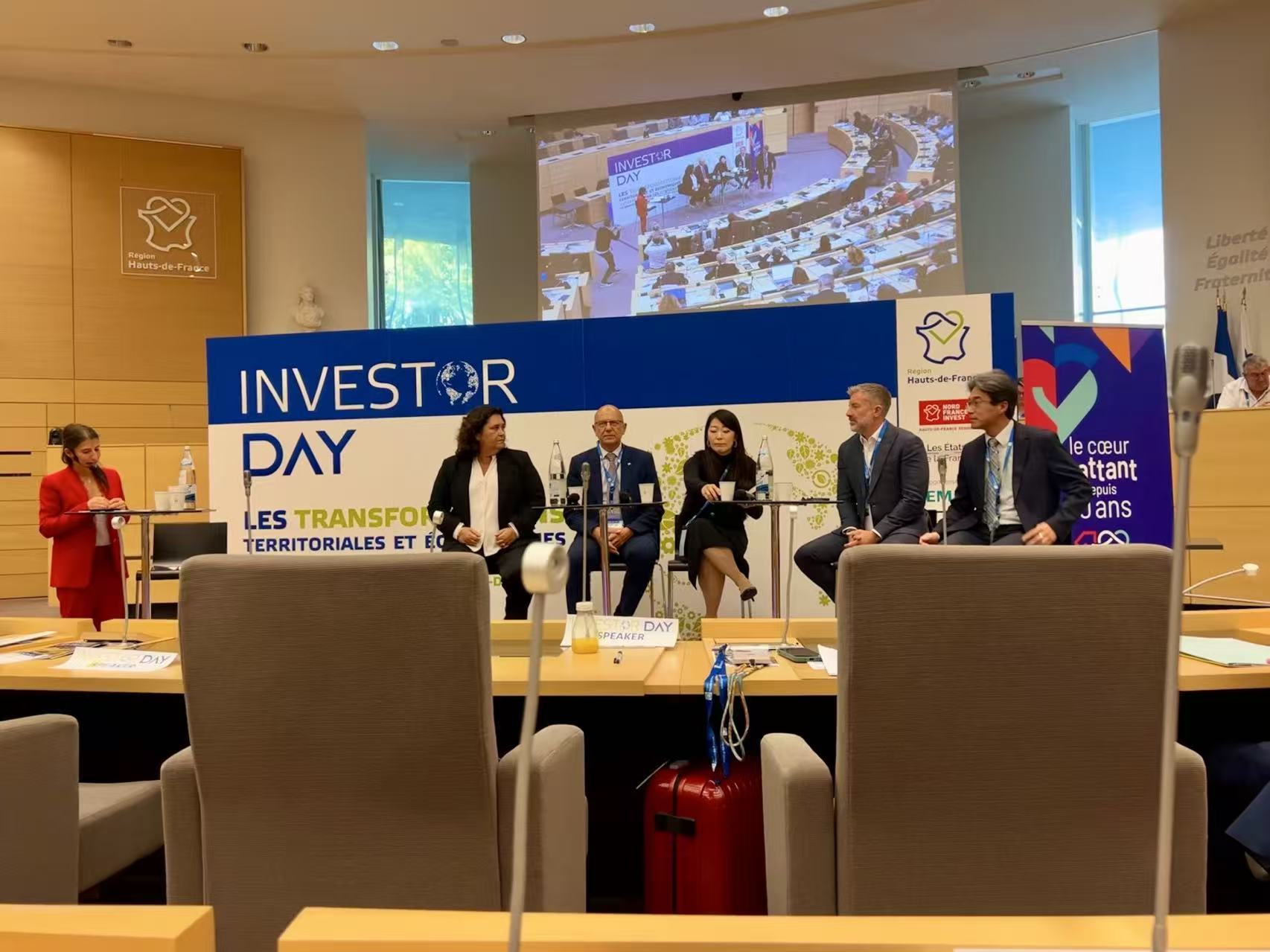
I attended the sixth edition of the Hauts-de-France Region’s Investor Day on 14 October 2026, at the regional headquarters. In the room: international companies, industrial leaders and experts in economic relations.
The exercise was not about communicating intentions, but about measuring where the region actually stands — and what remains to be built. Three ideas came up in almost every session: anticipating needs, developing skills, and strengthening coordination between the public and private sectors. Together, they sketch out a method for reindustrialization.
1. A region that has changed face — and that attracts
The region went through severe industrial hardship before transforming itself into a territory fully integrated into European value chains. That was one of the day’s central messages: foreign investment is presented there as a direct driver of job creation and local development.
And the projects are no longer announcements: they have sites, timelines and industrial partners.
AI and data centers. SoftBank has committed up to €75 billion in France, including a first phase of €45 billion for 3.1 GW of AI data center capacity in Hauts-de-France. Three sites have been identified — Dunkirk (Loon-Plage), Bosquel and Bouchain, on a former EDF thermal power plant. The project includes an industrial cluster at the Port of Dunkirk with Schneider Electric, assembling prefabricated power modules, and an explicitly stated ambition: to make the region a European AI hub. The project backers mention several thousand construction jobs, close to a thousand industrial jobs at the Schneider site, and 300 to 400 specialist robotics positions.
Batteries. Several gigafactories are in production or ramping up — notably AESC in Douai and ACC in Douvrin — with further projects under way in Dunkirk. This is France’s « battery valley ».
Decarbonization and basic industry. A French low-carbon cement technology, based on industrial by-products, has a logistically well-positioned site in the region, with part of its output intended for export.
Food processing. McCain, present in France since 1981, has announced a €300 million investment program across its French sites — cooperation with farmers and subcontractors being presented as the condition for success.
Logistics. The Seine-Nord Europe canal is cited as a long-term driver of regional development.
The sectors described as promising are electricity, the energy transition, digital and artificial intelligence. The question is therefore no longer whether the region attracts, but whether it can keep pace with what it attracts.
2. Attractiveness is not decreed
On this point, speakers were aligned: French attractiveness rests on five pillars — regulatory and tax stability, the quality of skills, suitable infrastructure, a coherent industrial policy, and the quality of dialogue between public authorities and companies.
Two nuances are worth keeping. First, the continuity of public policy matters almost as much as its content: an industrial investment is decided over ten years, not three. Second, state and regional support is seen as decisive in speeding up projects — and adapting regulation is presented as a condition for industrial decarbonization.
There is also consensus on a sensitive point: external recruitment will not be enough. Existing teams will need training, which requires lasting partnerships with universities, engineering schools and industry.
3. Dependencies: the thread running through the whole debate
The geopolitical context featured heavily in the discussions: US-China tensions, the war in Ukraine, the return of protectionism, and challenges to international trade rules.
Against that backdrop, one observation was stated plainly. China is described as simultaneously a major industrial competitor, an unavoidable trading partner and a source of dependency for Europe. And excessive reliance on a single partner is identified as a source of fragility: it limits strategic decision-making capacity and technological development.
Three directions were proposed: diversify supplies, preserve strategic skills, and act in a more coordinated way at European level — including by defining priority sectors and defending European interests, notably in the debate on trade imbalances, while keeping dialogue open.
In batteries, these dependencies translate into very concrete difficulties: higher construction and investment costs in France, heavy reliance on raw materials and components from Asia, demanding quality and certification requirements, a shortage of specialized skills, and long lead times to qualify components and suppliers.
4. The real work: ramping up
One more operational contribution served as a reality check. A recently completed plant is still running at only part of its nominal capacity: ramping up depends less on machines than on training people — external recruitment falling short, scarce local skills, occasional reliance on foreign experts, and operational issues to resolve. Figures were mentioned in the room; I am not repeating them here, as they were not confirmed.
This is the point public debate addresses least, even though it decides success: between the plan and production lies the work of industrialization, process and knowledge transfer. It is a matter of execution, not ambition.
5. The interface: a quiet, but decisive link
One conclusion seems to be shared by the projects that succeed. No value chain becomes local overnight: part of the equipment, components and raw materials still comes from Asia, with long qualification cycles. In that landscape, the quality of the interface between the European customer and Asian manufacturing capacity becomes a competitive factor — and a matter of industrial security.
That is the ground we work on. Indus2Green, based in Saint-Quentin, supports European manufacturers at that junction between European requirements and Asian manufacturing, helping the region’s industrial projects to keep their deadlines:
- automotive-grade quality control (IATF 16949) built into the manufacturing process, rather than an end-of-line inspection;
- European requirements taken into account from the design stage: CE marking, the EU Battery Regulation, REACH;
- a bilingual interface and local technical support, so French teams gain autonomy rather than dependence;
- training technicians on the equipment, in French.
Our experience is that of a French engineer with twenty years in the European automotive industry, including several years in direct contact with industrial projects in Hauts-de-France and with Asian supply chains. We do not claim to replace the reindustrialization effort: it is public, funded, and involves players with the means to deliver. We work on a more modest link — the one that determines whether a delivered project turns into a plant that produces.
What I take away
- Hauts-de-France does not lack industrial projects: AI and data centers, batteries, decarbonization, food processing, logistics.
- Attractiveness there rests less on incentives than on stability, skills, infrastructure and the quality of public-private dialogue.
- The question of dependencies — and of their necessary diversification — is now central to industrial policy, without breaking off commercial dialogue.
- The real bottleneck is ramping up: training, industrialization, and the reliability of supply chains.
Let’s talk
If you are working on an industrial project in Hauts-de-France — or on securing a supply chain for equipment and components — we would be glad to discuss it.
🌐 www.indus2green.com
📍 Saint-Quentin, Hauts-de-France, France
📩 robin.luo@indus2green.com
Indus2Green — Made With China, Managed by European Standards.
Chinese industrial excellence — with European rigour in addition.
An attendee’s account of Investor Day 6 of the Hauts-de-France Region (14 October 2026). Public figures quoted come from information published by the project developers.